


Most people know the Atlantic hurricane season runs from June 1st through November 30th. But those who live along the Gulf and Atlantic coast states and most insurance claims adjusters will tell you that there is a “season within the season” when it comes to hurricanes. And that’s where things can really change quickly.
The first two months of the season are usually pretty calm. June averages only one named storm every other year, and July has averaged one named storm per year since 1950. We have seen a few early bird tropical storms pop up in May over the past few years, but these are rarely threats to life and land.
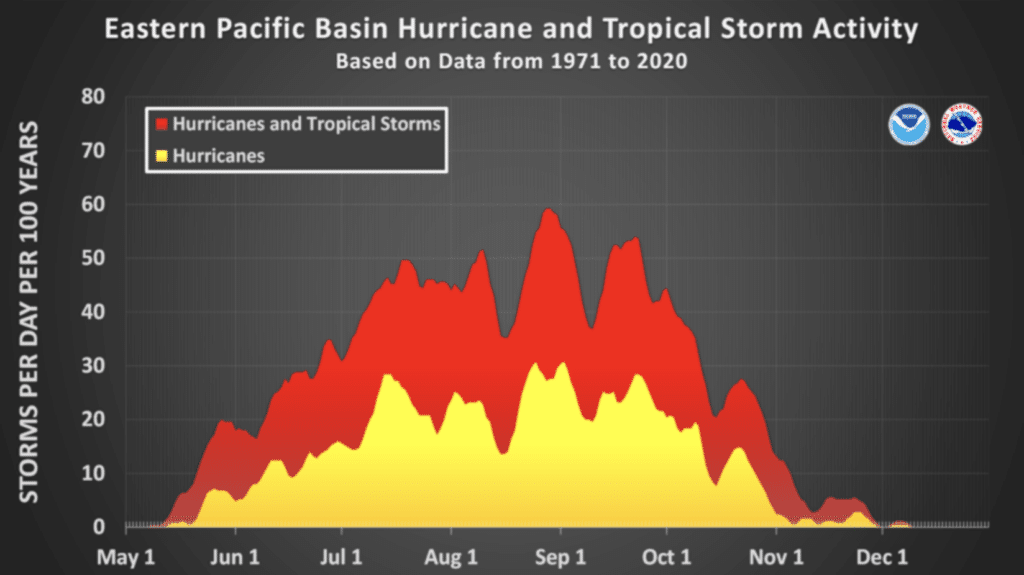
The real action, or the season within the season, happens from August to mid-October, with September 10th being the true peak of the season. This time frame is when the most powerful and destructive hurricanes occur. The African dust settles a bit while the waves increase, the currents and winds become more favorable, and the ocean temps are at their warmest during these months – all of which provide a much friendlier breeding ground for catastrophic storms.
Over the past six years, these destructive hurricanes all struck the U.S. during the peak of the season:
- 2024: Helene & Milton (Both made landfall in Florida, but damages were widespread)
- 2022: Fiona (Puerto Rico, then Atlantic Canada); Ian (Florida)
- 2021: Ida (Louisiana); Nicholas (Texas)
- 2020: Isaias (North Carolina); Laura (Louisiana); Sally (Florida/Alabama border); Delta (Louisiana)
- 2019: Dorian (North Carolina)
- 2018: Florence (North Carolina); Michael (Florida)
- 2017: Harvey (Texas); Irma (Florida); Maria (Puerto Rico); Nate (Louisiana, Mississippi)
There are never any guarantees when it comes to predicting hurricanes. We’ve seen years where predictions were way lower than usual, some that were way too high, and some that were almost dead on. After all, one huge storm can change everything.
While slightly tweaked downward, 2025 updated forecasts issued by NOAA’s National Hurricane Center and Colorado State University are still calling for up to 18 named storms, with winds of 39 mph or greater, and 2-5 major hurricanes of Category 3 or stronger.
The experts, for the most part, usually get a lot of those factors right. It’s what those storms DO that really matters to us, as residents and as people in the insurance industry. Will they hit the U.S.? At what strength? Where? Or, like last year, do they form into giants that peacefully head up into the Northern Atlantic? This continues to be the most unpredictable factor and why seasoned adjusters know to stay ready come this time of year.
Insurance claims adjusters know that even if they haven’t worked a CAT yet this year, the season within the season can change everything. Though July, things have been relatively quiet, but experts know that’s unlikely to last. If you’re interested in being a claims adjuster and working catastrophe deployments, it’s not too late. Check out your state licensing courses or give us a call. We’re here to help, every step of the way.

