


Whether you’ve already failed your adjuster licensing exam or you’re worried you might, one thing is clear: this test feels like a make-or-break moment. And when it doesn’t go your way? The emotional weight hits fast. Frustration. Doubt. Confusion about what’s next. And it’s not just about the retake fee. What about the lost time, missed income, and shaken confidence a failed attempt can cost you?
At AdjusterPro, we’ve worked with thousands of students as they prepare for licensure, and we’ve seen first-hand what leads to success, what can hold people back, and the most common challenges aspiring adjusters face on their path to getting licensed.
In this article, we’ll walk you through exactly what happens if you fail the adjuster exam. You’ll learn about waiting periods, retake fees, state-specific rules, and the often-overlooked costs that can catch you by surprise. More importantly, we’ll show you how to avoid common mistakes, prepare smarter, and confidently move forward toward your adjuster license.
Table of Contents
- How Often Do Students Fail the Adjuster Exam, and Why?
- What Happens If You Fail Your Adjuster Exam?
- How Much Does It Cost to Retake the Adjuster Exam?
- What Should You Do After Failing the Exam?
- How to Avoid Failing Your Licensing Exam Again
- Failing Your Adjuster’s Licensing Exam Is Not the End. What Should You Do Next?
How Often Do Students Fail the Adjuster Exam? Why?
According to the annual reports from the National Association of Insurance Commissioners (NAIC), first-time adjuster licensing pass rates typically range from 50% to 70%. That means up to 50% of students fail their first attempt.
In some states with more comprehensive licensing requirements, that number can be even higher. For example:
- California, Texas, and New York exams are known for their broad content coverage and complex question structure.
- States (like California, Georgia, and Michigan) that use national testing providers like Pearson VUE or Prometric tend to follow standardized formats, but local regulations can still impact difficulty.
Every state has state-specific objectives on its exams; without knowledge of your state’s unique policies and procedures, you’ll find the exam especially challenging.
Why Do So Many People Fail the Adjuster Licensing Exam?
Here are the most common reasons students don’t pass:
- Studying the wrong material. Not all prep courses cover state-specific material, so some students have the potential to walk into the exam with knowledge gaps.
- Test anxiety. Even well-prepared students can freeze up under pressure, especially if it’s their first time taking a licensing exam.
- Unfamiliarity with the exam content or format. Multiple-choice doesn’t always mean straightforward; some questions are intentionally tricky to test your judgment.
Failing your adjuster exam doesn’t reflect your intelligence, work ethic, or ability to work in this career. It simply means you need to re-approach your preparation with the right tools, strategy, and mindset.
The exam is a barrier to entry, not a measure of your worth. And for many successful adjusters, failing is simply a part of the journey.
What Happens If You Fail Your Adjuster Exam?
You’ll have the option to retake the exam, but how and when you can do so depends on your state’s specific rules. Failing your exam understandably feels like hitting a wall, but the reality is, it’s more like taking a detour.
How Long Do You Have to Wait Before Retaking the Exam?
Most states enforce a waiting period between exam attempts, typically between 24 and 72 hours. While many states allow quick retakes, others impose longer waiting periods, sometimes up to 180 days, after multiple failed attempts. On top of that, reapplying for approval can add another 30 days, depending on the state’s processing time.
Check your state’s department of insurance or testing provider for the exact policy.
Are There Limits on How Many Times You Can Retake the Exam?
Yes, some states place a cap on retake attempts before requiring additional steps:
- In many cases, you can take the exam up to 3-5 times (although with adequate preparation, hopefully you won’t need to).
- After that, you may need to complete additional education or get approval from the state licensing board to continue testing.
For instance, some states require students to wait 30 days or complete a remedial course after multiple failed attempts.
Do You Need to Re-Register or Re-Apply For the Licensing Exam?
In most states, you don’t need to submit a brand-new application unless:
- Your application has expired due to inactivity.
- You’ve reached the maximum number of attempts and must requalify.
What you will need to do is reschedule your exam through the testing provider.
How Do You Reschedule a Retake?
Retaking your exam usually involves:
- Logging into your testing provider account (Pearson VUE, Prometric, or state-specific platform).
- Choosing a new date and time at an available testing center or for an online proctored session.
- Paying the retake fee (more on that below).
- Confirming your ID and test details to ensure continuity with your prior attempt.
The process is typically done online and takes just a few minutes.
How Much Does It Cost to Retake the Adjuster Exam?
Most retake fees average from $40–$65 depending on your state and testing provider, but in some cases, they can be as high as $100 per attempt. These costs can add up quickly, especially if multiple attempts are needed, making preparation the best investment you can make.
What Are Some of the Other Costs Associated With Exam Failure?
When most people think about failing the adjuster exam, they focus on the retake fee, but that’s just the surface: the true cost of failure includes a mix of time, money, momentum, and confidence, and it can impact your path into the industry more than you might expect.
1. Time: Lost Days (or Weeks) of Career Progress
Every failed attempt means lost time.
Depending on your state’s retake rules, you may have to wait days or even weeks before you can try again. That might not seem like much at first, but if you’re eager to land a job or meet a hiring deadline, it can cause serious delays. If you’re actively applying for roles or trying to onboard with a firm, one failed exam could mean missing your window of opportunity.
2. Money: Retake Fees, Training, and Missed Income
In addition to the exam fee, there are secondary costs that add up quickly:
- Re-registering for prep courses
- Taking time off work to test or study
- Missing out on paid adjuster work while waiting to get licensed
For many aspiring adjusters, especially career changers, this isn’t just frustrating; it’s financially stressful. Every week you’re not licensed is a week you’re not earning.
3. Motivation: The Emotional Toll of Falling Short
Failing an exam can shake your confidence, especially if you expected to pass or are changing careers later in life. It’s not uncommon for students to walk away from the process entirely after one or two failed attempts, not because they weren’t capable, but because they felt defeated.
We’ve worked with students who:
- Stopped studying for months due to shame or burnout
- Questioned whether they belonged in the industry at all
These emotional costs aren’t often talked about, but they’re real, and they’re worth acknowledging.
4. Reputation: When Employers Are Watching
In some cases, especially when you’re already in communication with a hiring manager or recruiter, a failed exam can subtly impact how you’re perceived. While most employers understand that failure happens, multiple failed attempts without progress can raise concerns about your preparedness or reliability.
If you’re onboarding through a firm, repeated delays might affect your placement or cause the company to move forward with someone else.
Similarly, for direct-hire adjusters, passing the licensing exam (especially on the first or second try) can influence how you’re ranked during onboarding. When carriers train large groups at once, performance in prelicensing can affect who moves forward and who doesn’t.
What Should You Do After Failing the Exam?
Put simply, if you fail your exam, your next steps are to regroup, review, reschedule, and build a new strategy.
Step 1. Pause, and Regroup
Failing the exam is not unusual, and it doesn’t reflect your ability to succeed in the industry. It is simply an opportunity to adjust your approach and move forward with a more effective plan.
Step 2. Request and Review Your Score Report
Most testing providers (like Pearson VUE or Prometric) will give you a score breakdown by topic area. This is one of the most valuable tools at your disposal; it tells you exactly where you fell short.
This isn’t about beating yourself up; it’s about finding the knowledge gaps that you can tackle for the next exam attempt.
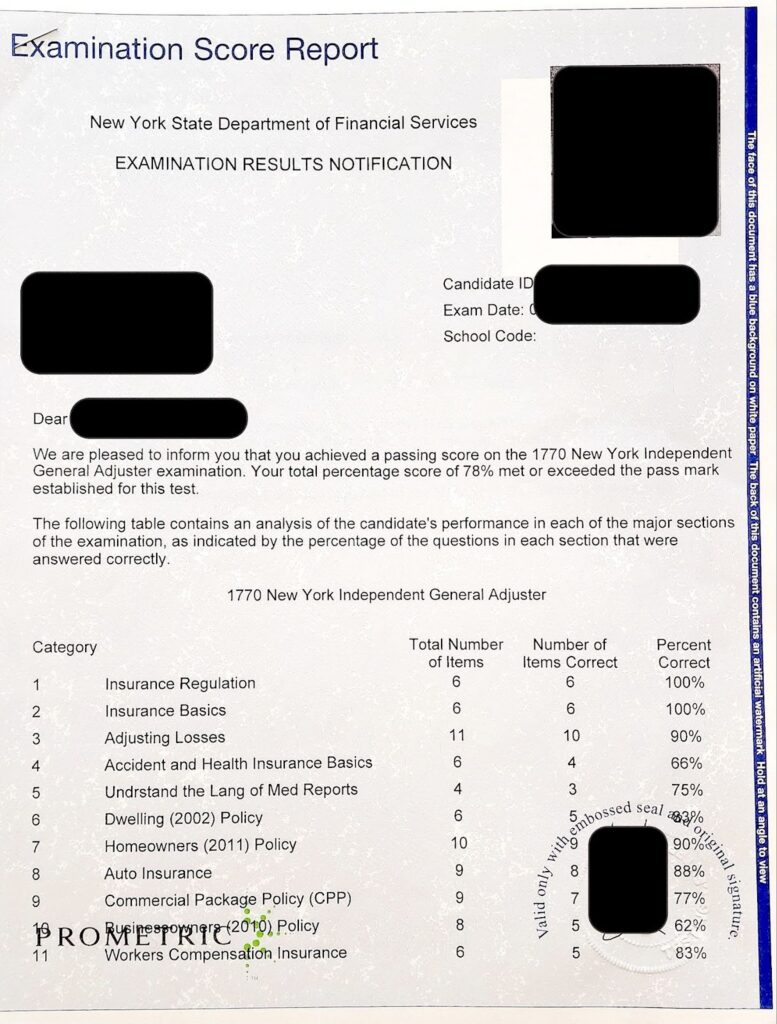
Step 3. Analyze What Really Went Wrong
It’s tempting to tell yourself you just need to “study harder.” But vague effort won’t get different results.
Instead, ask yourself:
- What were my studying habits? Typically, allowing yourself time to process and go over your information multiple times helps with concepts and information retention.
- Did I use materials specific to my state? Do I have the state-provided “Exam Outline?”
- Was I thrown off by the format of the questions?
- Did nerves or test anxiety play a role?
Most students fail because of a combination of factors, not just a lack of knowledge. Recognizing the real reason helps you avoid repeating the same mistake.
Step 4. Reschedule, But Study First
When you reschedule the licensing exam, don’t immediately rush into another attempt just because you can. Give yourself some time to study smarter with the insights from your score report.
When you’re ready, log into your testing provider’s site, pay the retake fee, and choose a date that gives you time to prepare, not just time to “hope” you’ll do better.
Step 5. Refresh Your Study Plan
This is the moment when a change in strategy can make all the difference. If you studied alone the first time, consider a guided program. If your materials weren’t state-specific, consider a state-specific program.
A fresh approach beats repeating the same plan that didn’t work.
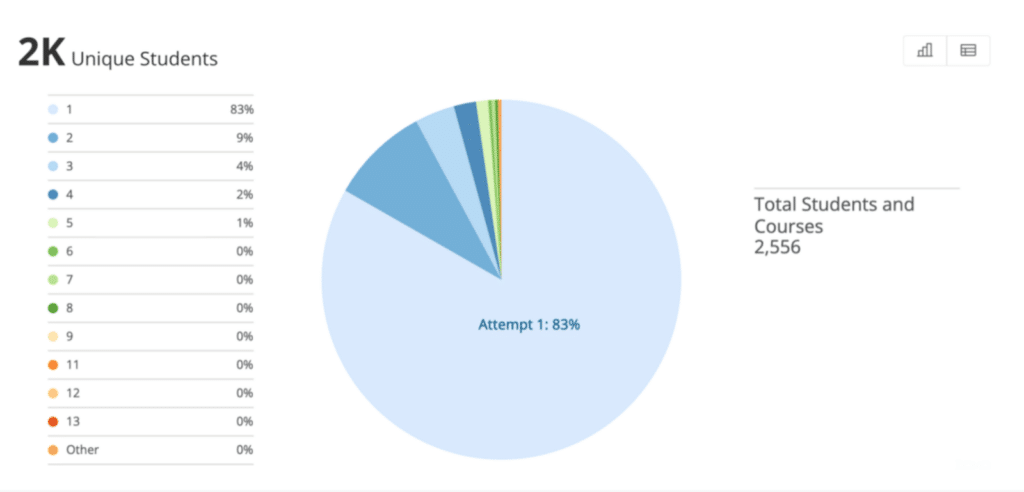
Using a structured course can significantly increase your chances of passing: nationwide, first-time pass rates for adjuster licensing exams typically range between 50% and 70%. According to our pre-licensing data from (2020–2025), 83% of AdjusterPro students passed on their first attempt (see screenshot below).
| Note: Students who complete AdjusterPro pre-licensing courses for FL, TX, AR, or AZ take the state licensing exam with us at the end of the course. However, students who take other states’ pre-licensing or exam prep courses will take the state licensing exams administered by third-party testing providers. We do not have access to those exact exams or their results, so our data is based on our pre-licensing courses to ensure accuracy. |
Other reputable online course providers, such as Kaplan and WebCE, also report pass rates that exceed the national average, reinforcing the value of a guided learning approach.
Keep in mind, no provider knows the exact questions that will appear on your state exam. The state provides an “exam outline,” and course providers build their curriculum based on that outline. We research, write, and fact-check content to align with those topics, so you don’t have to dig through that material yourself.
If your adjuster licensing exam provides feedback on the topics you struggled with, be sure to review it. This information helps direct your study focus when you prepare for your retake.
| If you are regrouping and have questions or are struggling with next steps not answered here, please reach out to our Customer Engagement Team. We are always happy to help. |
How to Avoid Failing Your Licensing Exam Again
If you’re preparing for a retake, the goal isn’t just to put in more hours; it’s to study more effectively. Many students pass on their next attempt by refining their strategy and focusing on the areas that matter most.
1. Focus on State-Specific Content
Students often fail because their study materials are too generalized and don’t match their state’s specific licensing requirements. Insurance regulations and adjuster licensing guidelines vary widely from state to state, and overlooking those details can cost you.
Before you begin studying again, make sure your materials:
- Are up to date for your state
- Cover both national and state-specific laws, forms, and processes
- Include any updates to your state’s licensing rules
2. Use Practice Exams to Sharpen Test-Taking Skills
Test-taking is a skill, and practice matters. Taking timed, realistic practice exams can help you:
- Get used to the wording and structure of questions
- Identify weak areas quickly
- Build confidence under time pressure
Student feedback (and conversations in forums like Facebook and Reddit) consistently show that taking multiple practice exams helps people feel more confident and perform better on test day. With AdjusterPro, you can retake your practice exam as many times as you need. If you choose a different provider, we recommend checking to ensure their course includes repeatable practice exams so you can fully prepare before the real thing.
3. Study with a Strategy, Not Just More Time
Rather than rereading material or watching the same videos again, shift to a more targeted study plan:
- Review your past exams’ weak areas first
- Use active recall techniques like flashcards or quizzes
- Focus on understanding key concepts, not just memorizing definitions or questions
Common mistake: Students often review what they already know well instead of spending time on the material they struggled with.
4. Know When to Get Support
If your first attempt was close and you understand where you went wrong, a self-guided review may be enough. But if you’re unsure what to do differently, structured help can save time and frustration.
Guided training programs, like those from AdjusterPro, offer:
- Researched and fact-checked explanations of state exam topics (based on the state’s exam outline)
- Targeted reviews and quizzes
- Built-in accountability and “exam-ready” status reports
This is exactly the extra layer of structure that helps students turn things around.
Failing Your Adjuster’s Licensing Exam Is Not the End. What Should You Do Next?
By now, you know exactly what happens if you fail your adjuster exam, and how to regroup, refocus, and retake it with confidence. From understanding the retake process to recognizing the hidden costs, you’re equipped with the information most people don’t have until it’s too late.
While failure is a temporary setback, it’s certainly not final. If you’re preparing to retake the exam, use the resources available to you, like exam outlines, study aids, flash cards, and state website articles.
Don’t need a course but have questions not addressed in this article? Looking for more specific details? Please reach out to our Customer Engagement Team.
Wondering what AdjusterPro courses offer to help you study? Check out “What Do AdjusterPro’s Courses Look Like In the New Learning Center?”
At AdjusterPro, we’ve helped thousands of people earn their adjuster license, many of whom started out just like you, facing the disappointment of a failed attempt. You’re not the first to face this challenge, you won’t be the last, and you can absolutely overcome it. You’ve got this!

