


When you’re responsible for staffing and training insurance adjusters at scale, exam pass rates aren’t just a performance metric. They directly influence onboarding timelines, operational efficiency, and client confidence.
AdjusterPro provides insurance licensing and exam preparation for adjusters nationwide. Over the past 20+ years, we’ve trained 100,000+ adjusters and partnered with 7 of the top-10 U.S. insurance companies to support large-scale licensing and onboarding efforts and continuing education courses and credits.
That experience has given us a practical view into what tends to support exam success, and where outcomes become less predictable. It’s also why we’re clear that AdjusterPro isn’t the right fit for every organization or training model. Context matters, especially when pass rates are involved.
The goal of this article isn’t to make blanket claims. It’s to help you evaluate whether our approach aligns with how your organization hires, trains, and deploys adjusters, and whether it meaningfully addresses the challenges you’re trying to solve.
Table of Contents
- Perspective On The Hidden Costs Of Adjuster Licensing Exam Failure
- What AdjusterPro Can (and Can’t) Report on Pass Rates
- Pass Rates When Using Recommended Best Practices
- What Drives These Pass Rates?
- A Real-World Enterprise Example
- Can AdjusterPro Reduce Licensing-Related Costs?
- Who AdjusterPro Is (and Isn’t) a Fit For
Some Business Perspective On The Hidden Costs Of Adjuster Licensing Exam Failure
Failed licensing exams don’t just slow individuals down; they quietly disrupt entire claims operations.
Consider an enterprise onboarding 50 new adjusters. If a meaningful percentage aren’t fully prepared to pass on the first attempt, the primary cost isn’t the exam itself. It’s time.
Training schedules slip. Adjusters sit idle. Assignments are delayed. Claims queues back up. What often starts as a licensing issue quickly becomes an operational bottleneck that compounds across teams.
Weeks-long onboarding extensions can force managers into reactive mode (reshuffling resources, extending training waves, or delaying deployments), while policyholders and carrier partners feel the downstream impact through slower claim resolution and missed SLAs.
With many AdjusterPro courses, there is no additional cost to retake the exam. The real value of higher first-attempt pass rates isn’t avoiding fees, it’s keeping licensing on schedule and getting adjusters productive sooner, saving you the lost time and expense incurred when candidates aren’t fully prepared and must wait to retest.
That’s why first-attempt pass rates matter operationally–not as a vanity metric, but as a signal of onboarding efficiency and predictability.
What AdjusterPro Can (and Can’t) Report on Pass Rates
Licensing pass rates are often discussed without enough context, which can make comparisons misleading.
While we can’t share confidential or identifiable data from enterprise or employer-sponsored partners (and pass rates vary by company), we can report outcomes from environments where results are directly measurable.
This includes states where pre-licensing exams are administered within AdjusterPro as part of the course experience (FL, TX, AR, and AZ).
For other states, licensing exams are administered by third-party testing providers. Because we don’t have access to those exams or official score reports, those outcomes are not included in our internal pass-rate calculations.
This approach limits what we can claim, but ensures the data we share is accurate and verifiable.
AdjusterPro Pass Rates When Courses Are Studied Using Recommended Best Practices
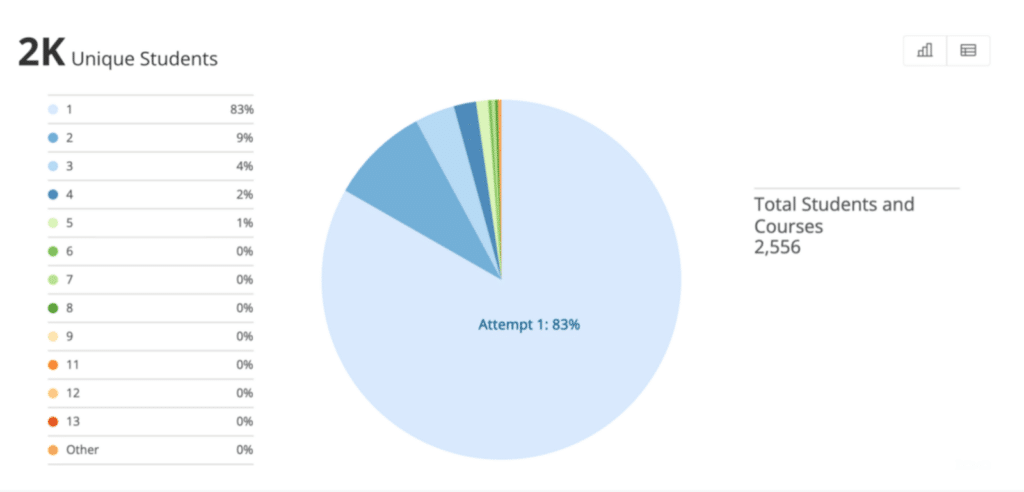
AdjusterPro has a significantly higher success rate than the national average. Based on our pre-licensing data from 2020–2025, 83% of AdjusterPro students passed their exam on the first attempt (see screenshot below). In contrast, the typical first-time adjuster licensing pass rates across the U.S. generally range between 50% and 70%, according to annual reports from the National Association of Insurance Commissioners (NAIC). This means that up to 50% of students nationwide fail on their first try.
| Note: Students who complete AdjusterPro pre-licensing courses for FL, TX, AR or AZ take the state licensing exam with us at the end of the course. However, students who take other states’ pre-licensing or exam prep courses will take the state licensing exams administered by third-party testing providers. We do not have access to those exact exams or their results, so our data is based on our pre-licensing courses to ensure accuracy. |
Other reputable online course providers, such as Kaplan and WebCE, also report pass rates that exceed the national average, reinforcing the value of a guided learning approach.
Keep in mind, no provider knows the exact questions that will appear on your state exam. The state provides an “exam outline,” and course providers build their curriculum based on that outline. We research, write, and fact-check content to align with those topics, so you don’t have to dig through that material yourself.
What Drives These Pass Rates?
When pass rates improve, it’s rarely due to chance.
Across enterprise programs, outcomes tend to be more predictable when certain conditions are met:
- Curriculum mapped directly to state exam outlines, so time is spent on exam-weighted topics
- Modular, self-paced eLearning, allowing learners to revisit complex material and progress consistently
- Practice exams that reflect real exam structure and difficulty, not just content recall
- Ongoing content updates to reflect regulatory or outline changes
- Administrative dashboards that give managers visibility into learner progress and readiness
In many organizations, licensing prep still relies on static or outdated materials, making it harder to identify readiness gaps early. A more structured approach can help learners focus their effort and reduce uncertainty heading into exam day.
A Real-World Enterprise Example
To see how these elements can come together in practice, here is one historical enterprise case study:
A large BPO was onboarding adjusters across multiple states and struggling with first-time pass rates hovering around 30%. The issue extended beyond testing — hiring timelines were slipping, payroll costs were rising, and confidence from a major national carrier was at risk.
After aligning on goals and constraints, both teams collaborated to design a repeatable training and onboarding strategy focused on accountability, visibility, and readiness — not just course access.
Over time, results improved significantly:
- First-time pass rates in a key state rose to 90%+
- One cohort achieved a 100% first-time pass rate on a particularly difficult state exam
- Training waves were completed faster than planned, saving over $200,000 in projected payroll and overhead costs
- Retention targets were met and client confidence was restored
The difference wasn’t the exam itself, but how training, accountability, and readiness were managed before candidates ever took the test.
Can AdjusterPro Reduce Licensing-Related Costs?
In many cases, AdjusterPro can reduce licensing-related costs, depending on volume, timelines, and how licensing fits into your onboarding model.
Organizations typically see the biggest impact when:
- Licensing is a gating factor for deployment
- Hiring occurs in structured waves
- Delays materially affect claims volume or SLAs
Under those conditions, higher first-attempt pass rates can support:
- Faster time-to-productivity
- Fewer onboarding extensions
- Less remediation work for managers and trainers
- More predictable staffing outcomes
Where licensing timelines are flexible and delays don’t materially affect operations, the impact may be more limited.
Who AdjusterPro Is (and Isn’t) a Fit For
AdjusterPro is often a strong fit for organizations that:
- Onboard adjusters at scale
- Operate across multiple states
- Need predictable licensing timelines
- Value visibility into learner readiness
- Rely on licensing as a prerequisite for deployment
AdjusterPro is likely not the right fit if:
- Licensing delays do not materially impact deployment or claims volume
- Your organization already maintains in-house licensing curriculum and instructors
- You prefer informal or exclusively in-person training models
Next Steps
If your organization is looking to reduce licensing friction, improve onboarding predictability, and gain clearer visibility into exam readiness before test day, AdjusterPro may be worth exploring.
A practical next step is to review your hiring volume, onboarding timelines, and how licensing fits into your deployment process. From there, it becomes easier to determine whether a more structured, data-informed approach would meaningfully support your goals.
If AdjusterPro Enterprise sounds like it could be a fit, or if you’re simply comparing approaches, we’re happy to have a conversation. Our team can walk through your specific use case, answer questions, and candidly help you determine whether our approach aligns with how your organization operates. Please reach out with any questions.
Curious to hear what students are saying? Check out the article: “AdjusterPro Review: What You Need to Know Before You Buy.”

