


You’re ready for a career change, but the options feel overwhelming—and most require years of schooling or thousands in tuition. You want something stable, something real, and you want to start now.
You’re not alone. We talk to people every day who are stuck in jobs they don’t love, wondering if there’s something better out there. If that’s you, know this: there is a career path that values real-world skills, offers financial stability, and lets you help people every day—without starting from scratch.
In this guide, we’ll walk you through exactly how to become an insurance adjuster in 5 simple steps—from licensing to landing your first job. No fluff. It takes hard work, but it’s a relatively quick and straightforward process—especially when compared to the cost and time investment of a college or technical degree. Most of the requirements can be completed online at your own pace.
In this article, we’ll cover the five steps to becoming an insurance adjuster:
- Determine if insurance adjusting is a good fit for you
- Choose the type of adjuster you want to be
- Get your adjuster license
- Learn essential skills
- Land your first job
Let’s get started.
STEP 1: IS INSURANCE ADJUSTING RIGHT FOR YOU?
An insurance claims adjuster investigates and evaluates insurance claims to determine how much an insurance company should pay. They can work for insurers (staff adjusters) or independently. We consider insurance adjusting to be a “hidden gem” career in America. It’s a stable industry with excellent earning potential, but it’s not for everyone. Here’s what you need to know:
- Hard and Soft Skills: Basic requirements include being 18+, a licensed driver, and a legal resident. Success, however, depends on your soft skills—self-discipline, work ethic, and communication.
- Demand & Salary: Adjusters are needed in any economy. Independent adjusters can earn over $100K annually, while staff adjusters typically make $45K to $80K.
- Catastrophe Work: During major events, like hurricanes, adjusters can earn a year’s salary in a few months. But it’s tough work in high-pressure environments, and demand is unpredictable.
- Industry Outlook: More adjusters are retiring than entering the field. Meanwhile, severe weather events are increasing, fueling more demand.
Step 2: Choose the Type of Insurance Adjuster You Will Be
There are different paths within insurance adjusting:
- Staff Adjusters: Full-time employees of insurance carriers.
- Independent Adjusters (IAs): Contractors who work for multiple IA firms.
- Catastrophe Adjusters: Travel to disaster zones and can be staff or independent.
- Inside/Desk Adjusters: Handle claims remotely via phone and email.
As you gain experience, you may specialize in different areas such as auto, workers’ comp, marine, or catastrophe (CAT) adjusting. Regardless of what career path you envision, you will need to get licensed to be successful.
FAQ: How long does it take to become an insurance adjuster? Most people can become licensed adjusters in 2–6 weeks, depending on their state’s requirements and personal schedule.
STEP 3: GET YOUR INSURANCE ADJUSTER LICENSE
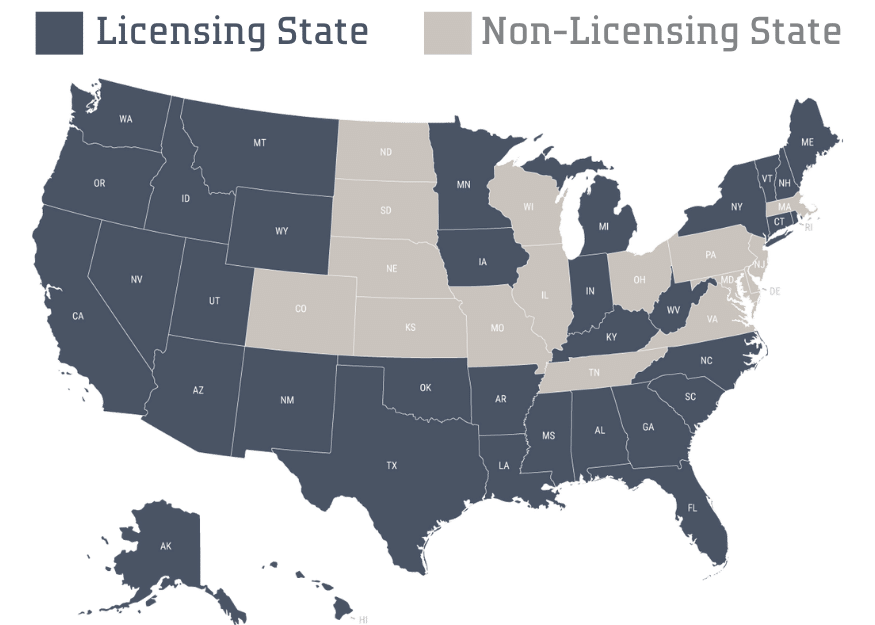
To start, you’ll need to know whether your home state licenses insurance adjusters. (Most do.) However, Colorado, Kansas, Nebraska, South Dakota, North Dakota, Missouri, Illinois, Wisconsin, Tennessee, Ohio, Virginia, Maryland, Pennsylvania, New Jersey, and Massachusetts do not license adjusters. Iowa began licensing insurance adjusters in July 2025.
If Your Home State Issues Adjuster Licenses: If you live in a licensing state, you must obtain your home state license first. This will allow you to apply for reciprocal licenses in other states.
If Your State Doesn’t License Insurance Adjusters: While you might not need a license to work insurance claims in your state, you will need one to work claims across state lines, like in the case of a catastrophic event. We recommend getting a Designated Home State, or “DHS” license from Florida or Texas. Both offer excellent reciprocity, and you can complete your pre-licensing requirements and take the exam online. If you want to learn more about the DHS license and why it’s so important to your success, visit our When Does an Adjuster Need a DHS article.
- AdjusterPro Courses: Prepare for your licensing exam or, for some states like Texas and Florida, take your exam online.
- Non-Licensing States: Even if not required, obtaining a DHS license enhances your job prospects.
- Reciprocity: After getting your initial home state or DHS license, apply for reciprocal licenses in high-claim states.
FAQ: How much does it cost to get an adjuster license? Licensing fees vary by state and vendor, but most can expect to spend between $200 and $500. Total licensing costs include your exam prep or pre-licensing course, state exam, application, and background checks if required. You can see a state-by-state breakdown of costs in our Licensing & Fees Guide.
FAQ: Can I be an insurance adjuster without a license? If you live in a nonlicensing state, you can adjust claims in your state without a license. However, you can’t work claims in other states or travel to catastrophe zones. IA Firms need flexible adjusters who can go where the work is, so most won’t hire you without a license, even if your state doesn’t require one.
STEP 4: LEARN THE MOST ESSENTIAL SKILLS
Getting your adjuster license is the first and most important step. Successful adjusters constantly build their toolkit:
- Xactimate Software: Learn to write claims with the industry-standard platform
- Adjuster Success Method: Get insider tips, best practices, and field readiness from veterans
- Construction Knowledge: Familiarize yourself with basic construction terms and techniques
- Estimating Property Damages: Take your estimating skills to the next level
“Proficiency in Xactimate is the single most important technical skill a new adjuster must acquire.”
Adam Gardiner, Co-Founder of AdjusterPro
IA Firms host a variety of in-person training and certification classes that are important for their contractors to attend. Once you start applying, it’s essential to stay on top of your emails, as that’s where they typically send information about upcoming events. Attending these trainings is a great opportunity to learn essential skills and make personal connections with potential employers.
STEP 5: LAND YOUR FIRST INSURANCE ADJUSTING JOB
Job hunting in the adjusting field requires preparation and persistence. Treat searching for a job as your job, and you will not be disappointed.
- IA Firm Outreach: Contact major and mid-sized firms. Don’t limit yourself to the top three.
- Tailored Resume: Build one that highlights adjusting-relevant skills.
- Total Adjuster Package: Combine licensing, Xactimate training, and career-launch tools.
- Roster Up: Apply strategically and follow up.
- Networking: Join industry associations and job boards.
- Stay Ready: Keep your licenses active. Be prepared to deploy quickly.
- Say “Yes!”: When you have an opportunity…take it!
Ready to get started?
Download our ebook to learn more about the job and explore if adjusting is the right fit for you. Whether you’re just exploring or ready to dive in, insurance adjusting is an in-demand, flexible career with strong earning potential. From licensing to skills to your first deployment, AdjusterPro is here to help.

