


How to Get Your Florida Insurance Adjuster License: A Strategic Guide for Future Catastrophe Responders
Florida is one of the busiest states in the nation for catastrophic insurance claims. If you’re aiming to build a career as an insurance adjuster in this high-demand market, getting your Florida insurance claims adjuster license is the essential first step. This guide walks you through exactly how to do that, including which license to choose, how to apply, maintain compliance, and take advantage of reciprocity opportunities.
Step 1: Decide Which Florida Adjuster License You Need
Before beginning the process, you must determine the correct license type for your situation:
- 6-20 Resident Adjuster – For Florida residents working independently or on staff.
- 7-20 Nonresident Adjuster – For adjusters licensed in their home state who ONLY want to work in Florida (note: We do not recommend this license except in very specific circumstances, as it offers no reciprocity).
- 70-20 Nonresident DHS Adjuster – Ideal for adjusters in non-licensing states who want to declare Florida as their designated home state.
- 3-20 Public Adjuster – For adjusters representing policyholders. There are more steps required to obtain this license, which you can see in this article.
- 4-40 Customer Representative – For Florida agency or insurance office employees.
Step 2: Meet Florida Adjuster Eligibility Requirements
Resident Adjusters Must:
- Be at least 18 years old
- Reside in Florida
- Be a U.S. citizen or legal alien with work authorization
Nonresident Adjusters Must:
- Be at least 18 years old
- Live outside Florida
- Be legally authorized to work in the U.S.
- Be licensed in their home state or apply via DHS if in a non-licensing state
Step 3: Qualify for Your Florida Adjuster License
There are two main paths to adjuster licensing in Florida:
- Complete a State-Approved Designation Course – Like AdjusterPro’s Florida Certified Adjuster Designation. Students who complete our online pre-licensing course and pass the included exam are exempt from taking the Florida state adjuster exam.
- Pass the Florida Adjuster State Exam – Take the required pre-licensing education hours and pass the state exam in person from a testing provider.
By far, the quickest and easiest way to get your license is to take a state-approved designation course. This is how most Florida adjusters obtain their licenses, and the path we recommend.
You may also qualify for an exam exemption if you:
- Hold a General Lines or Public Adjuster license in Florida
- Hold a similar out-of-state license within 90 days of Florida residency
- Hold an insurance degree with 18+ credit hours in core courses
Step 4: Apply for Your Florida Adjuster License
Make sure you apply for the Florida license type that you passed the exam for and that meets your needs. This will be designated by you on the application.
Use Florida’s MyProfile system to:
- Submit your application
- Upload Proof of Citizenship
- Pay the licensing fee
- Schedule fingerprinting (LiveScan preferred for speed)
Applicants concerned with criminal background questions can get more information on the FLCFO Criminal History page.
Step 5: Florida License Appointment
In Florida, adjusters must be appointed to legally adjust claims.
- Independent Adjusters: Must self-appoint via the MyProfile system (eAppoint).
- Select the “Access eAppoint” button under “Apply”.
- If you haven’t used eAppoint, you must first register and will need to select “Register to become an appointing entity.”
- Once in the eAppoint Workbench, select the required tab (New Appointment, Renew Appointment, or Terminate Appointment) and follow the instructions on the page.
- Pay the $60 fee.
- Appointments must be renewed every 24 months during your birth month.
Need help completing your application? Check out our Florida adjuster application instructional video below. We’ll walk you through the entire process, step by step.
Step 6: Stay Compliant
Florida Adjuster Continuing Education (CE) Requirements:
- 24 hours of CE every two years (including 4 hours of Law & Ethics)
- After 6 years of licensure, only 20 hours required (16 elective + 4 Law & Ethics)
- No CE credit for repeat courses within the same 24-month period
There is no formal license renewal required for Florida adjusters, provided the licensee is appointed correctly during application process. Failure to maintain CE compliance can lead to cancellation of the appointment or license termination. AdjusterPro offers over 200 hours of continuing education for Florida claims adjusters.
How much does it cost to get a Florida Adjuster License?
| Item | Cost |
|---|---|
| AdjusterPro Pre-Licensing Course + Exam | $299 |
| Florida Licensing Application Fee | $50 |
| License ID Fee | $5 |
| Fingerprinting Fee | $50.75 |
| Appointment Fee | $60 |
| Renewal Fee | $0 |
Reciprocity: Expanding Your Reach
Florida grants reciprocal licenses to adjusters licensed in states with reciprocity agreements. If your home state doesn’t license adjusters, the 70-20 DHS License allows you to use Florida as your licensing home base. If you want to learn more about reciprocity and why it’s vital to your success, visit our Reciprocity: The Truth About Adjuster Licensing Agreements Between States blog article.
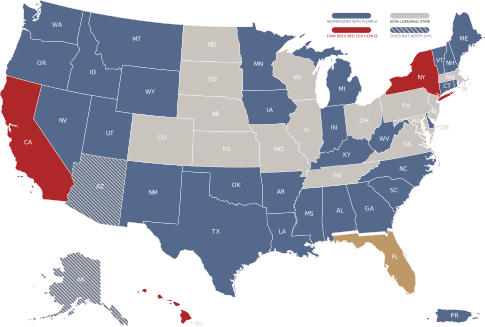
Note: California, Hawaii, Iowa, and New York do not have reciprocity agreements with Florida.
Use our reciprocity map to see state-by-state reciprocity and prioritize which licenses to apply for first.
Launching a Florida Adjusting Career
Getting your Florida adjuster license unlocks opportunities in one of the country’s busiest catastrophe zones and is vital to your success. Whether you’re a resident or nonresident, following these steps ensures you meet all regulatory requirements and position yourself for reciprocal growth.
Next Steps: Get your home state or designated home state adjuster license.
Start with the right license, choose your licensing path wisely, and stay compliant to succeed long-term.
Need Help?
- Florida Department of Financial Services: Website
- Phone: 1-877-693-5236
- Email: [email protected]

