


Artificial intelligence has made it easier than ever to access information quickly. With a few prompts, AI tools can explain insurance concepts, summarize claims processes, and even outline licensing steps. That convenience naturally raises a question many prospective adjusters are now asking:
Can I use AI instead of buying an adjuster training course?
How accurate is the AI information about insurance topics?
At AdjusterPro, we’ve helped over 100,000 students nationwide pass their adjuster licensing exams, many on their first try. We’re also well aware that purchasing a course can be expensive depending on your budget, so it’s fair to ask whether AI or DIY study methods can realistically replace a prep course.
The truth is, if your state requires a pre-licensing course, you’re required to complete an approved pre-licensing course. If your state does not require a pre-licensing course, traditionally, you’d take an exam prep course (and some students are experimenting with AI to study and research the materials).
While AI is viewed like an efficient and fast alternative to a purchased course, to use AI with true confidence, you will need to fact-check the material, which will create a lot more work for you. AI engines are notorious for saying things without checking facts with total confidence. That having been said, AI can be a helpful resource, but only when its limitations are clearly understood, and you account for them in your research.
Table of Contents
- How AI Helps When Preparing for Your Adjuster Licensing Exam
- How AI Falls Short In Preparing You for the Adjuster Licensing Exam
- How Accurate Is AI Research Regarding State-Specific Statutes and Regulations?
- The Real Decision You’re Making (It’s Not AI vs a Course)
- How to Use AI If You Opt for It Over a Course
- Is AI the Right Licensing Exam Training Option for You?
- Final Verdict: Can AI Replace Adjuster Training?
How AI Helps When Preparing for Your Adjuster Licensing Exam
AI functions much like an advanced search engine that delivers summaries and explanations faster than traditional web searches. It can provide detailed, palatable answers to your questions. It can explain terminology, summarize high-level concepts, and help users review material they already recognize.
In addition to this, AI is great at scanning through large documents and answering questions. You can also have conversations with AI, and ask it for study aids (like fill in the blanks, pop quizzes, and application questions).
AI is an especially fantastic resource when you provide it with a source you know to be factually accurate, and ask it to help you study that material, and help you retain it.
AI works best when you treat it as a study assistant, not a source of truth. When you provide it with materials you already trust (such as state exam outlines, official statutes, or reputable course materials) it can help you summarize, reorganize, and retain that information more effectively. Used this way, AI can support your studying process, reinforce learning, and save time.
How AI Falls Short In Preparing You for the Adjuster Licensing Exam
Just like any search engine, AI pulls from a wide range of sources. As we continue to assess the state-of-the-art AI chats and Large Language Models (LLMs), we consistently find that information may be accurate, current, and relevant, but often responses are not contextually accurate. The danger is that AI presents all responses with the same level of confidence, regardless of accuracy.
Over and over again, we confirm that it can “hallucinate,” and as more and more data is added to your chat and run through the system, your data algorithm can get confused.
This creates a risk for exam preparation. Licensing exams often test nuanced details, specific terminology, and state-specific rules. AI may provide a general explanation that sounds correct but fails to align with how questions are structured or how regulations are actually enforced.
If you aren’t on the ball, fact-checking (even down to the phrase), you risk taking the exam with inaccurate information, and even worse, bringing problematic information to your job and to the policyholder.
It’s not impossible to use AI to prepare for an exam, but to ensure accurate information, fact-check diligently, ask AI for its sources, and make sure your information is specific to your state and up to date. For example, if you are preparing for the NY exam and AI bases its information on statutes from 2015 rather than an addendum issued in 2026, your information will be out of date.
How Accurate Is AI Research Regarding State-Specific Statutes and Regulations?
When asked to summarize or interpret statutes, AI sometimes oversimplifies the information, omits critical conditions, or blends rules from multiple states. While that sounds like a flaw (and it can be), this behavior can also be a short-term benefit for learners in the early stages of exam preparation.
Insurance statutes are often dense, technical, and difficult to read without context. AI’s tendency to simplify can make complex legal language more approachable, helping students grasp the general intent of a law before diving into its finer details. For someone who is brand new to adjusting or still building a mental framework for how claims regulations work, this high-level interpretation can reduce overwhelm and make studying feel more manageable.
In other words, AI can be useful for answering questions like:
- “What is this statute generally trying to accomplish?”
- “How does this rule fit into the claims process at a high level?”
- “What is the basic responsibility being described here?”
The drawback here is that licensing exams (and real-world adjusting) often hinge on the exceptions, qualifiers, and exact wording that AI is most likely to gloss over. When details such as “unless,” “except,” timing requirements, or state-specific conditions are simplified away, a student may walk away with an incomplete or even incorrect understanding of the rule.
This is where AI’s strength becomes its weakness. What makes statutes easier to understand at a glance can also create false confidence if the learner doesn’t go back to the original source. For exam prep, this means AI summaries should be treated as a starting point—not a final answer—especially when studying state-specific laws and regulations.
Used carefully, AI can help you build a foundational understanding faster. Used carelessly, it can blur critical distinctions that matter on exam day and in the field.
A Real Life Case Study of AI Error Interpreting a Statute
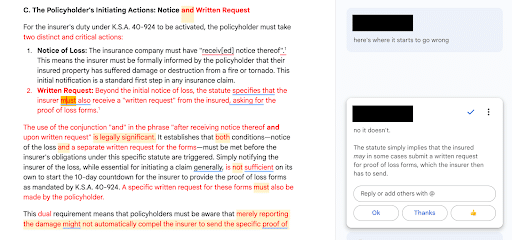
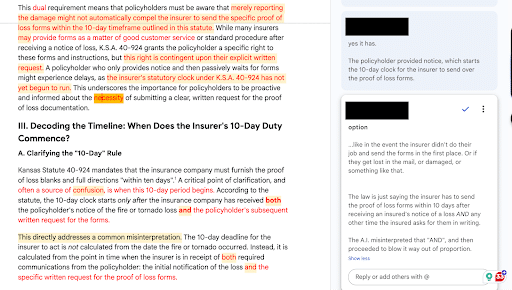
In May of 2025, our Product team tested AI’s interpretation of Kansas Statute 40-924 through a “Deep Dive” with Gemini. The resulting answer and explanation were completely the opposite of the actual truth. Take a look:
| The AI deep dive started by incorrectly assuming that a claimant needs to submit a written request for proof of loss forms in addition to notifying the insurer of a claim. What follows is several pages of explaining how this process works, but it’s all completely wrong because of this initial misinterpretation. And it all stems from the A.I. mistaking the meaning of one word from the law: “and”. In reality, whenever there’s a loss, the policyholder just needs to send the insurer notice of a claim to start the process. Then the insurer will send the proof of loss forms to the policyholder within 10 days. If, for some reason, the policyholder still doesn’t have the forms after 10 days (say, for example, the insurer didn’t send them correctly or they got lost in the mail), then she can send a written request for the insurer to send the forms again. It’s the insurer’s legal responsibility to send the proof of loss forms. If you look at the regulation below, it’s pretty obvious that it’s not primarily the policyholder’s job to make a written request for proof of loss forms. Section 6. Failure to Acknowledge Pertinent Communications (a) Every insurer, upon receiving notification of a claim shall, within ten working days, acknowledge the receipt of such notice unless payment is made within such period of time. If an acknowledgement is made by means other than writing, an appropriate notation of such acknowledgement shall be made in the claim file of the insurer and dated. Notification given to an agent of an insurer shall be notification to the insurer.… (d) Every insurer, upon receiving notification of claim, shall promptly provide necessary claim forms, instructions, and reasonable assistance so that first party claimants can comply with the policy conditions and the insurer’s reasonable requirements. Compliance with this paragraph within ten working days of notification of a claim shall constitute compliance with subsection (a) of this section. So the whole gist of the “deep research” is wrong. This is a good example of the dangers of relying on AI for self-study. In instances like this, the fatal flaw in the AI’s explanation hinges on literally just one word. If you had used this AI deep dive to study for an exam, you would probably get questions wrong that dealt with the very beginning of the claims process. Curious to see more details? Here are some screenshots of the behind-the-scenes, line-by-line analysis: |
Curious to see more details? Here are some screenshots of the behind-the-scenes, line-by-line analysis:
AI is constantly evolving, and will improve in time, but be on guard; even one small error like this can completely offset your understanding of a local law.
The Real Decision You’re Making (It’s Not AI vs a Course)
If you’re asking whether you can use AI instead of buying an adjuster licensing prep course, you’re really trying to answer a different question:
“What is the most reliable way to pass my licensing exam and start my career without unnecessary delays or mistakes?”
AI feels appealing because it’s fast, flexible, and inexpensive. A prep course feels like a commitment of time and money.
But the real risk isn’t choosing the “wrong” study tool, it’s selecting a study method that is biased towards telling you what you want to hear, can’t assess source accuracy with discretion, and ultimately leads you into a false sense of confidence if you aren’t rigorous.
When you pass an adjuster exam, the margin for error is small. Questions are precise, statutes are nuanced, and state-specific wording matters. A single misunderstanding can mean a failed exam, a retake fee, and weeks or months of lost time.
So the decision isn’t AI vs course.
The decision is how much uncertainty you’re willing to accept in a high-stakes exam.
How to Use AI If You Opt for It Over a Course
AI can still be valuable, but only if used carefully and deliberately.
To optimize your use of AI, you must:
- Treat it as an advanced search tool, not a source of truth
- Independently verify information using official state resources
- Confirm that all material is state-specific and current
- Cross-check statutes, licensing requirements, and regulations directly
- Recognize that some AI-generated content may be incomplete, inaccurate, or out of context
- Ask it to be truthful, and not just tell you want it thinks you want to hear
- Ask it for its sources, and check them
Using AI effectively requires knowing what to look for and what to question. Without that baseline knowledge, it becomes difficult to identify errors or gaps in the information provided.
In practice, this means AI works best as a supplement for people who already understand the structure of adjuster licensing and regulation—not as a replacement for foundational training.
Is AI the Right Licensing Exam Training Option for You?
You may prefer to use AI instead of buying a course if you:
- Already have industry experience
- Understand regulatory differences by state
- Are comfortable verifying information independently
AI is not for you if:
- You do not like doing your own research and fact-checking information
- You want direct, verified information that has been reviewed by industry experts
- You want to move through at a consistent, reliable pace
- You want complementary study materials and free, state-specific practice exams
Adjuster training courses are built around researched, fact-checked, and structured material designed to reduce these risks. AI, by contrast, simply provides search data in a confident tone, based on patterns and searches; it does not validate accuracy or applicability.
Final Verdict: Can AI Replace Adjuster Training?
So, is AI a good replacement for a licensing course for insurance adjusters? Our honest opinion is that, currently, AI cannot replace an adjuster training course. Some states, like Texas and Florida, require you to take an approved pre-licensing course before you take your exam. AI cannot replace this course.
If you do not have to take a pre-licensing course, you can opt for DIY study, use AI, or take an exam prep course.
Just remember, while AI can be a helpful resource, it functions as a glorified search engine and summarizer, not a verified educational authority. It presents information confidently, but confidence does not equal correctness. Some content may be inaccurate, outdated, or taken out of context, especially when dealing with complex, state-specific insurance regulations.
Adjuster training courses exist to provide vetted, accurate, and structured education. AI can support learning, but it does not replace the research, fact-checking, and compliance focus built into a formal course.
Used correctly, AI can be part of the learning process. Used as a replacement, it introduces risks that many prospective adjusters underestimate.
Whether or not you use AI to prepare for your exam, make sure you are studying the exam outline established by your state, and know what is required in your state.
If you have questions, we are here to help.

